STEM Education


Rodni
An exciting project for STEM education. STEM stands for Science, Technology, Engineering and Mathematics.
This project aims to enthuse young students Year 5 to Year 9 (9-13 years) about the world of programming and micro controllers and show them that it is both interesting and accessible.
It is a modular programme built around the Arduino and is designed to deliver quick success whatever the level of the student. The pieces allow for wide creativity and demonstrate that coding is not just for nerds but is fascinating and useful for everyone.
The objective is to excite young students about the possibilities that these inexpensive micro-controllers bring and encourage them to start exploring them on their own, increasing their interest in science and technology as a career choice.
The Rodni project is being developed in association with STEM Team East, an education charity that promotes STEM in schools. More information on STEM Team East can be found at http://www.stemteameast.org.uk
An exciting project for STEM education. STEM stands for Science, Technology, Engineering and Mathematics.
This project aims to enthuse young students Year 5 to Year 9 (9-13 years) about the world of programming and micro controllers and show them that it is both interesting and accessible.
It is a modular programme built around the Arduino and is designed to deliver quick success whatever the level of the student. The pieces allow for wide creativity and demonstrate that coding is not just for nerds but is fascinating and useful for everyone.
The objective is to excite young students about the possibilities that these inexpensive micro-controllers bring and encourage them to start exploring them on their own, increasing their interest in science and technology as a career choice.
The Rodni project is being developed in association with STEM Team East, an education charity that promotes STEM in schools. More information on STEM Team East can be found at http://www.stemteameast.org.uk

The many guises of Rodni

What will yours be?
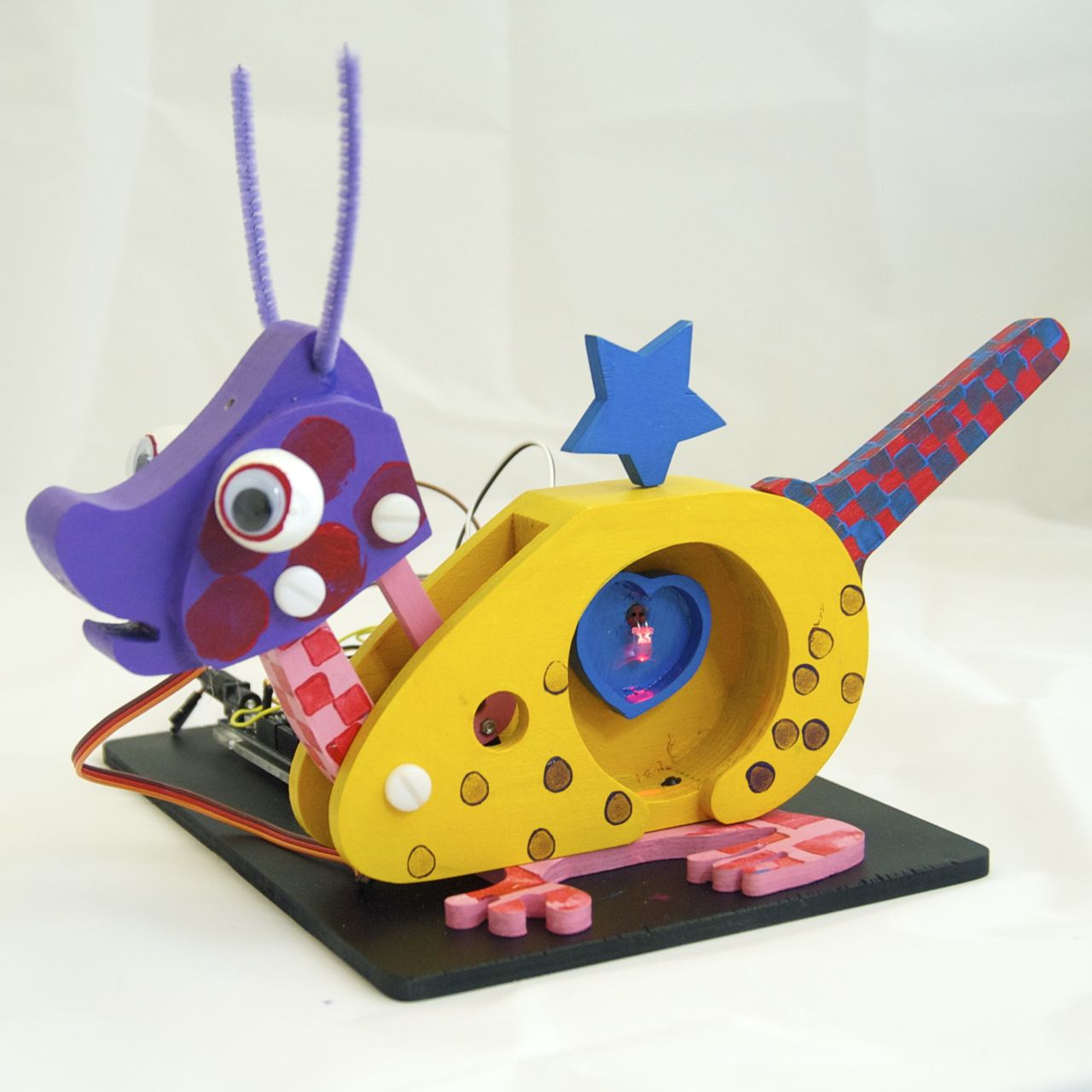
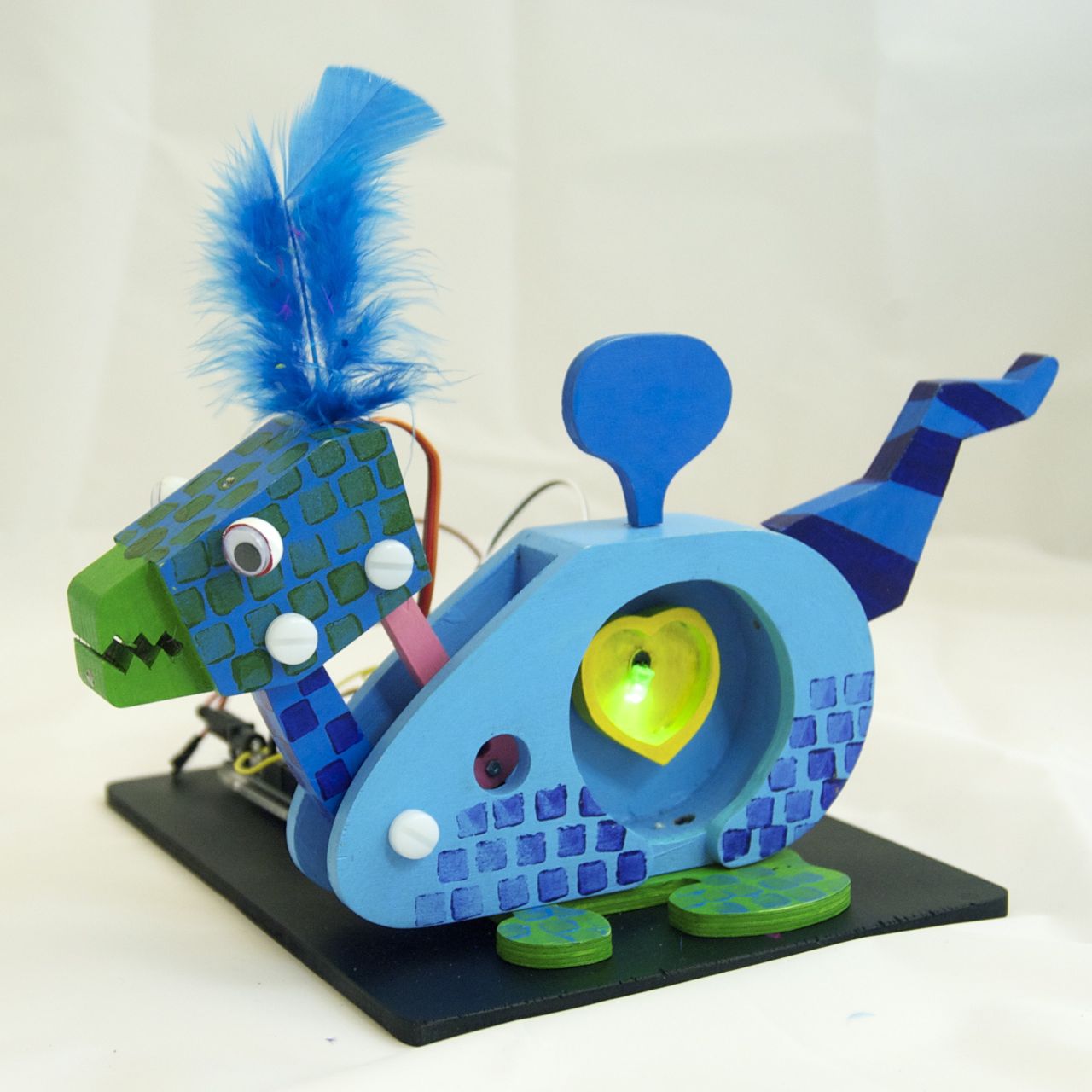


As all parts are interchangeable a set of 12 Rodnis has the creative potential to make at least 1,000,000 configurations, so every student can be creatively stimulated to make their own version.


Rodni is built on a baseboard that has room to support an Arduino and breadboard so the project can be easily moved.

Rodni Features
Programming capabilities
Rodni is supported by a guide book, made in an easy access comic book style and a teacher presentation slide set.
Instruction is given on basic programming and then the student is challenged to customise the action.
For instance:
Success from a workshop is being measured by pre and post workshop survey of pupil's attitude to programming.
Initially Rodni is offered to schools in the UK as a guided workshop. 12 Rodnis are provided, together with a project leader. The school needs to provide sufficient PCs. A maximum of 3 students per PC is recommended. The project is targeted at school years 5 to 9.
Rodni kits and accessories are also available for purchase. The project fits well into D&T classes.
I am seeking sponsors for this project.
- Plug in body parts to stimulate creativity.
- Simple electronics to aid understanding.
- No soldering required.
- One sensor, one LED and one servo to keep it simple.
- Can be powered from a PC USB port. No need for separate power supplies.
- Can be powered from a 9v battery making it portable.
- Potential for schools to create their own parts - extending the project into Design and Technology.
- Appealing interactivity can be programmed despite simple set up.
- Sense of achievement can be attained at all levels.
Programming capabilities
Rodni is supported by a guide book, made in an easy access comic book style and a teacher presentation slide set.
Instruction is given on basic programming and then the student is challenged to customise the action.
For instance:
- Guidance is given on how to make the LED flash, then the student is challenged to make the heart "beat"
- Guidance is given on how to make the servo (head) move then the student is challenged to make it perform a sequence.
- Guidance is given on how to read the light sensitive resistor and how to use this to make the Rodni react to stimulus. The student is then challenged to make Rodni interactive. Further animation is also possible.
Success from a workshop is being measured by pre and post workshop survey of pupil's attitude to programming.
Initially Rodni is offered to schools in the UK as a guided workshop. 12 Rodnis are provided, together with a project leader. The school needs to provide sufficient PCs. A maximum of 3 students per PC is recommended. The project is targeted at school years 5 to 9.
Rodni kits and accessories are also available for purchase. The project fits well into D&T classes.
I am seeking sponsors for this project.
Video showing some of the possibilities with Rodni.
Rodni comes with fully illustrated instructions including a teacher presentation and a trouble shooting guide to get students started on this exciting adventure. They can be found in the STEM Shop.


Even a short Rodni class improves pupil's attitudes towards programming.
Graph below shows results following a 1 hour class for 23 mixed year 8 pupils, a 2 hour class for 9 year 8 boys and a 2 hour class for 32 mixed year 6 pupils
Graph below shows results following a 1 hour class for 23 mixed year 8 pupils, a 2 hour class for 9 year 8 boys and a 2 hour class for 32 mixed year 6 pupils


Rodni Display Team
7 Rodnis networked with i2c. This has been created for the Newcastle Maker Faire April 27/28 2013 to demonstrate some of the capabilities of Rodni. i2c networks are fairly easy to set up, using only 2 pins per Arduino and are a good way of introducing a team effort into more advanced Rodni exercises. The code is available on request.
7 Rodnis networked with i2c. This has been created for the Newcastle Maker Faire April 27/28 2013 to demonstrate some of the capabilities of Rodni. i2c networks are fairly easy to set up, using only 2 pins per Arduino and are a good way of introducing a team effort into more advanced Rodni exercises. The code is available on request.
STEM resources can be found on my Resources page.